
From Farm to Brand: How Marketing Can Transform the Future of Indian Agriculture
Talk of agriculture and most people picture crops in a field. But growing a good harvest is only the starting point. What happens once that produce leaves the farm — how it's priced, packaged, promoted, and finally placed in front of a buyer — often decides how much value it actually earns.
This is exactly where marketing has a role to play in Indian agriculture.
India grows an extraordinary range of produce — fruits, vegetables, grains, spices, dairy, and more. Yet most farmers have little say in how their output is eventually marketed. Produce typically passes through several hands before reaching the consumer, and the farmer is left with only a slice of the final price.
Marketing offers a way to shift this balance.
“The real opportunity for Indian agribusiness isn’t just to sell more — it’s to create more value, and make sure the consumer can see it.”
Turning a Commodity into a Brand
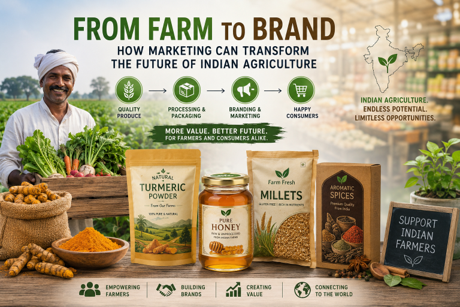
An unbranded agricultural product is usually judged on price alone. Once that same product is built into a brand, buyers start weighing other things too — quality, origin, packaging, and trust.
Take turmeric: it's sold in nearly every market, yet a brand that clearly tells buyers where it comes from, how it's grown, and how it's processed can stand apart in a customer's mind. The same logic applies to honey, spices, millets, fruit, and countless other farm products.
This is precisely why branding matters for agribusiness today. Building a brand isn't reserved for large corporations — Farmer Producer Organisations (FPOs), cooperatives, and small agri-ventures can just as easily build an identity of their own and reach customers directly.
Digital Platforms Are Lowering the Barrier
Digital tools have made marketing far more accessible than it once was. A small agribusiness can now use Instagram, YouTube, WhatsApp, or a simple website to introduce its products to the world.
Digital marketing isn't just about running ads. It's a chance to put a face behind the product, walk customers through how something is made, and answer their questions directly — all of which builds familiarity and, over time, trust.
Government efforts are reinforcing this shift too. Under the National Agriculture Market (e-NAM) initiative, the Government of India reports that 1,656 mandis had been linked to the platform by June 2026, with 1.89 crore farmers and 2.78 lakh traders registered on it.
Platforms like this won't solve every marketing challenge in agriculture, but they point clearly to where the sector is headed.
Knowing What the Consumer Actually Wants
Marketing isn't complete without understanding the buyer. Today's consumer rarely stops at “how much does this cost?” They also want to know where the product came from, how it was made, whether the quality can be trusted, and how it's packaged.
For agri-businesses, paying attention to these expectations can shape better decisions. A farmer may grow an excellent product, but if it's packaged poorly or its story is never told, that quality can go unnoticed by the very customer who'd value it most.
Marketing, done well, closes this gap between what farmers produce and what consumers are actually looking for.
Building Greater Value for Farmers
Marketing shouldn't be treated as an afterthought that begins once the harvest is in. Market demand can shape what farmers choose to grow, how the produce is graded, and whether it's processed or packaged before it's sold.
Institutional support for organised farmer groups is also growing. The Government of India has reported that 10,000 Farmer Producer Organisations have been registered under its central scheme.
FPOs give farmers a platform to come together, strengthen their bargaining power, and move into activities like processing, packaging, and branding — steps that individual farmers would struggle to take alone.
Looking Ahead
The future of Indian agriculture isn't only about growing more. It's equally about extracting more value from what's already being grown.
Marketing helps connect farmers to shifting consumer expectations. Branding gives agricultural products a sharper identity. Digital platforms open new lines of communication with buyers. And organised structures like FPOs help smaller producers step into these opportunities together.
To me, “farm to brand” captures an important shift in how we should think about agriculture. A farmer need not be seen only as someone who supplies raw material. Given the right knowledge, technology, partnerships, and marketing support, farmers and their organisations can become the creators of genuinely valuable products and brands.
The real opportunity for Indian agribusiness, then, isn't just to sell more — it's to create more value, and make sure the consumer can see it.